湖人旧将回归NBA~Shams报道,“盆栽哥”朗尼-沃克同意以1年330万加盟掘金。
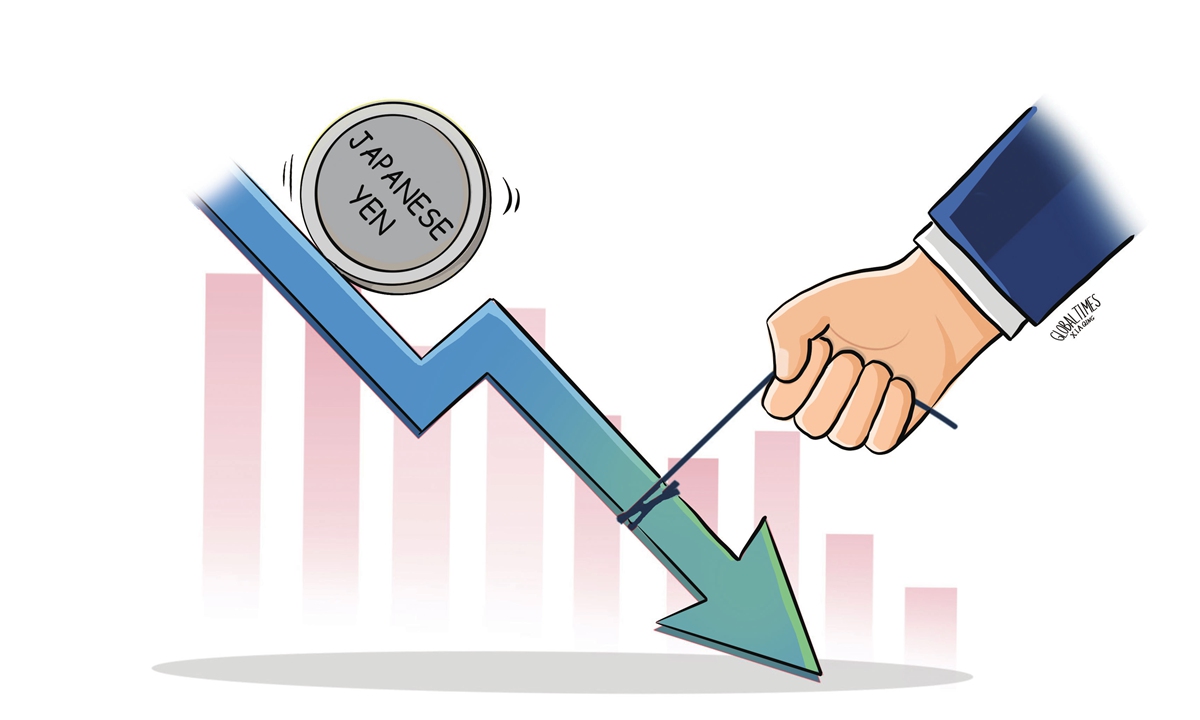
Illustration: Xia Qing/GT
The yen has weakened in recent days, edging closer to the psychologically important 160 level against the US dollar. The decline comes despite the widely watched move by Washington to join Tokyo in supporting the currency. Less than two weeks after the US-Japan intervention, the yen has given up roughly half of its gains, raising fresh questions over the effectiveness of coordinated efforts to stabilize the exchange rate.
Japan and the US had previously confirmed coordinated foreign exchange intervention to prop up the yen after the currency tumbled to a nearly 40-year low. At the time, some observers saw the move as potentially stabilizing the yen in the short term, although its longer-term impact remained uncertain.
However, the subsequent market reaction suggests that even the short-term effect may have been limited. After strengthening to about 155 per dollar in the days following the intervention from above 163, the yen had slipped back above 159 by Wednesday, less than two weeks later.
Questions have emerged over whether further support for the yen may soon be needed, and whether Washington would consider stepping in again. The previous intervention was seen by some observers as a test of market confidence: the unusual coordinated move had the potential to influence market expectations and discourage bets against the yen. But if market expectations remain largely unchanged, repeated interventions could deliver diminishing returns. The US may face a difficult trade-off. Another intervention could require greater resources and come at a higher cost, while refraining from further action could raise questions over the lasting impact of the previous effort.
Market commentary has added to the uncertainty. Axios published a report headlined "Yen's weakness shows market isn't done pushing," while some reports suggested that the impact of the US-Japan intervention was beginning to fade. Such narratives could weigh on sentiment toward the yen and reinforce market expectations that the currency's weakness may persist.
Washington's involvement in supporting the yen may reflect broader economic and policy considerations. These could include avoiding a scenario in which Japan sells US Treasury holdings to support the currency, as well as concerns that a weaker yen could give Japanese exporters a greater competitive advantage. These possible considerations suggest that the intervention alone does not fully address the underlying forces behind the yen's weakness. This may help explain why the market has so far been reluctant to view the move as a turning point for the currency.
Washington's decision to join the intervention may have reflected concerns, as some observers suggest, that the yen's prolonged weakness had begun to affect US interests. If markets remain unconvinced by the US-Japan intervention, one possible outcome is that Washington could push Japan to take more costly measures to support the yen. Such a scenario could instead create some strain between Washington and Tokyo.
Beyond short-term market dynamics, the yen's weakness also reflects deeper challenges facing the Japanese economy, making a sustained reversal difficult. The currency's prolonged weakness has been influenced by the interest rate gap between Japan and the US, while also reflecting longer-term concerns over the diminishing returns of Japan's traditional growth model.
This leaves Japan facing a delicate policy balance between supporting growth and stabilizing the currency. While lower interest rates could help boost economic activity, continued weakness in the yen may strengthen calls for Japan's central bank to consider further rate increases to narrow the interest rate gap with the US.
Japan's structural challenges mean that a sustained appreciation of the yen will not be easy to achieve. The question of whether to pursue stronger measures, even at the cost of some economic growth, has become more complicated as the US takes a role in the issue. Japan may face greater pressure to support the currency, even though doing so would be difficult and could carry broader economic costs.
The author is a reporter with the Global Times. [email protected]
。沃克上一次出现在NBA赛场还要追溯到24-25赛季,那时候因76人伤病满营,他作为救火奇兵短暂打过20场,场均入账12.4分;随后的2025年夏天,76人并未与其续约,沃克投简未果只能前往海外联赛淘金,上赛季在以色列的特拉维夫马卡比俱乐部效力;共出战了13场比赛,场均19.7分钟,可以输出15.6分2.2板2.1助1.2断,三项命中率为50.7%/40.7%/81.5%。沃克早年在马刺靠一头辨识度拉满的发型出圈,盆栽哥的外号就此叫响;而真正让广大球迷记住他,还得是湖人时期的封神一战。时间拨回2023年,沃克在万众瞩目的西半决G4打出生涯代表作;个人在末节独得15分率队攻城拔寨,帮助湖人主场104-101险胜勇士,成为湖人队史上自1997年的科比之后,季后赛末节独揽15分的替补球员。

二 | 无视嘴哥强投得手抢断快攻一气呵成点名萌神压哨命中强如阿king都得上前给朗尼挡拆封到脸上还进,萌神人已经麻了赛后詹眉两位带头大哥把激动落泪的沃克一把揽在怀里,促成了近10年来NBA最温馨的场面。可惜高光归高光,沃克始终没能在NBA彻底站稳脚跟。进攻手感时灵时不灵,防守又不见长,导致后续很难拿到稳定合同,这次能拿到掘金的Offer重返联盟,属实不易。

三 | 而且掘金的“诚意”肉眼可见,在此前匹配雷霆给斯潘塞·琼斯的两年1200万报价后,掘金就已经成为联盟唯一一个进入第二土豪线的球队;如今和沃克的这笔签约让他们的罚款在6860万的基础上暴增1650万,来到8510万美刀!关键是,目前掘金还没能和受限制自由前锋沃特森达成续约,若达成续约奢侈税将轻松破亿.....现在双方还在谈判拉扯阶段,据说沃特森对1600-1800万的均薪报价很不满意,谈崩了也不是没可能,大概率会走先签后换的路子。掘金目前已经跟骑士、雄鹿、快船好几支球队聊过了,商讨潜在的交易方案。当然也有另一种剧本:沃特森直接收下650万的一年资质报价,等明年夏天变身完全自由球员,再去冲更大的合同,选择更愿意效力的球队。






 发表于 00:53:02

 QQ好友和群
 QQ空间
QQ空间 腾讯微博
腾讯微博 腾讯朋友
腾讯朋友 收藏
收藏 支持
支持 反对
反对
 发表于 11:28:35


