
拳王
电力服务送上门 特色产业后劲足_我的网站

一 |
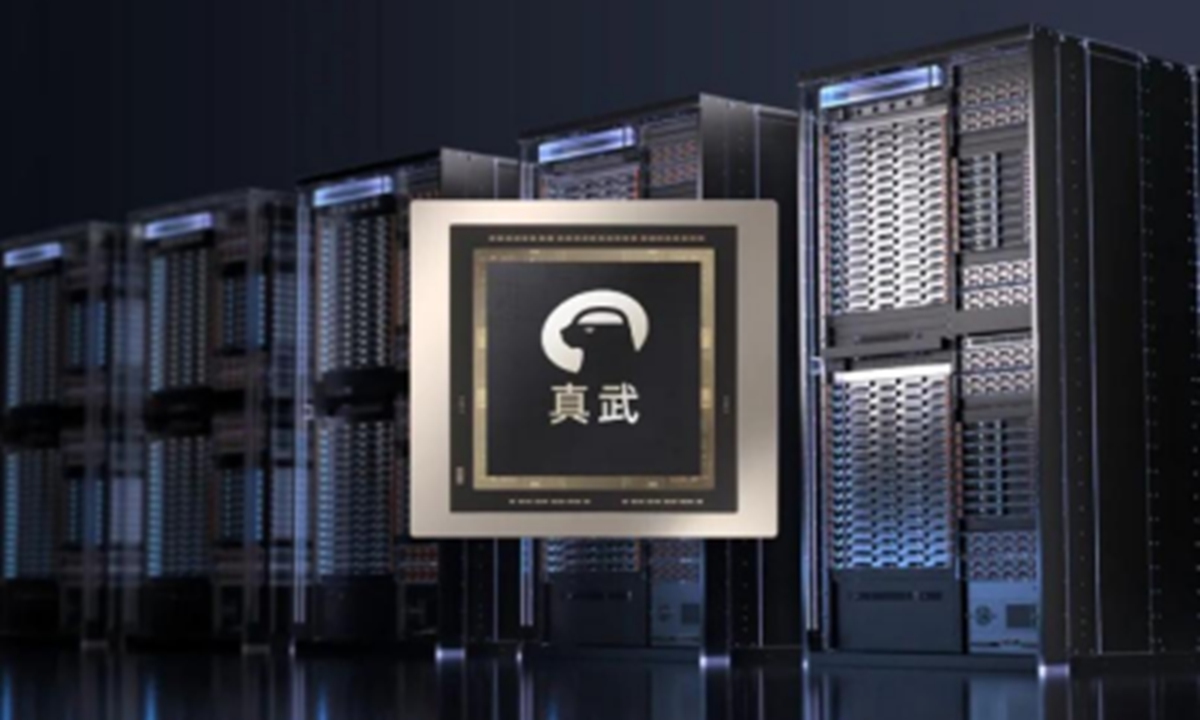
The instance is designed to handle inference for mixture-of-experts models with up to 10 trillion parameters, the company said in a statement sent to the Global Times on Wednesday.
This marks the first supernode-form computing architecture in China to successfully run large language models exceeding 2 trillion parameters, according to the company.
Industry expert Tian Feng told the Global Times that the commercial rollout of supernode infrastructure could significantly reduce training cycles, lower costs, and speed up iteration for AI developers requiring massive computational resources.
The company said the new instance has already been used to power commercial services for large language models such as KimiK3 and Qwen3.8Max.
The Lingjun Zhenwu M890 supernode instance supports FP8/FP4 low-precision computing. Through the ICNSwitch 1.0 chip, its scale-up interconnect scale has been expanded from 16 cards to 64 cards, with inter-card interconnect bandwidth boosted to 800 GB/s. Enterprises can provision 64-card, high-speed-interconnect computing units through the cloud without building their own data centers, according to the company.
In training scenarios such as autonomous driving and embodied intelligence, the instance delivers three times the training performance compared with the previous-generation Zhenwu 810E, the company said.
Ulanqab, where the supernode instance debuted, is one of Alibaba Cloud's five super data centers. The facility sources approximately 90 percent of its electricity from green energy, providing a low-carbon operating environment for high-density computing power.
Leveraging its climate, energy and network advantages, Ulanqab has transformed from "China's potato hometown" into the "token factory" - a term increasingly used in the AI industry to describe infrastructure dedicated to producing the digital building blocks generated by large language models.
By the end of 2025, the city had attracted 84 data center projects, including 81 intelligent computing centers, with total investment exceeding 500 billion yuan ($74.1 billion) and operational computing power reaching approximately 172,000 petaflops, ranking it firmly in the nation's top tier, according to domestic media reports.
On August 6, China's largest AI computing industrial park was completed and put into operation in Ulanqab. The project highlights a broader race in China to build massive AI data centers capable of supporting the next generation of AI models while addressing soaring electricity demand, according to Chinese experts.
In recent years, Inner Mongolia has been rapidly positioning itself as a global-scale AI computing center cluster. Major technology companies, including Huawei, Tencent, ByteDance and Alibaba; telecom operators China Mobile, China Telecom and China Unicom; as well as cyberspace infrastructure service provider VNET, have established computing facilities in the region.
As the AI industry gradually transitions from the training era to the inference era and large model parameters continue to expand, supernodes have become a central battleground for AI infrastructure.
Chinese vendors are accelerating deployments in this space. Huawei has commercially deployed more than 750 sets of its Ascend 384 supernodes across industries including internet, telecom operators, finance, education, healthcare, transportation and manufacturing. It is also the only domestic supernode to have trained state-of-the-art (SOTA) models.
Baidu AI Cloud has also launched its Tianchi 256-card supernode based on Kunlun chips, with support for major models including Wenxin, DeepSeek, GLM, and MiniMax.
Meanwhile, supercomputer manufacturer Sugon has unveiled China's first fully domestic 100,000-card AI supercluster Sugon 8000 (Dengfeng), integrating supercomputing and AI computing on a unified architecture. It has now been connected to the national supercomputing internet to provide computing services to government, research, and enterprise clients nationwide.
Tian, former dean of SenseTime's Intelligence Industry Research Institute, told the Global Times that the flurry of domestic supernode launches reflects a broader inflection point as China's AI sector pivots from training capacity toward efficient, large-scale inference.
The expert further said that the commercial viability of these systems - evidenced by Huawei's extensive deployed base, Baidu's rapid model adaptation and Sugon's integration into the national computing network - suggests domestic vendors are moving beyond proof-of-concept to genuine production-grade infrastructure, a prerequisite for sustaining the next wave of trillion-parameter model proliferation, Tian noted.
The move also underscores China's push for self-reliance in AI infrastructure as US chip export restrictions continue to tighten, Tian said, noting that, in the supernode domain, Chinese companies are shifting from imported graphics processing units toward homegrown interconnect chips and domestic compute clusters, a transition that could reshape value allocation across the AI industry chain.
。

二 | 李娇 张凤凯 5月20日一大早,南票区虹螺岘镇靠山屯虹豆香豆制品有限公司生产车间一片繁忙,在全自动豆制品加工流水线上,工人们有条不紊地进行豆制品制作和包装。 当天,国网供电公司的员工主动上门,帮助虹豆香豆制品有限公司检查生产车间供电设备运行情况。当检查到传送带附近的电源开关时,发现墙上的开关因为受潮有老化现象,存在安全隐患。于是,供电员工当场向车间负责人提出更换开关的整改建议,并向车间里的工人现场宣讲安全用电注意事项。

三 | “豆制品的特殊性是保质期短,尤其夏季高温天气,一旦停电,用不了半个小时,豆浆、豆腐脑和豆腐就会变质。所以,用电的事儿一点也不敢马虎,我们马上就安排人换新开关。”虹豆香豆制品有限公司负责人张瑞栋说。 虹螺岘干豆腐至今已经有300年历史。如今,虹豆香豆制品有限公司依靠传统工艺和现代技术相结合,以地产大豆加上国家级自然保护区虹螺山特有的天然山泉水,匠心精制,造就了虹螺岘干豆腐“干、薄、细、香、净”五大特点。如今,随着“虹豆香”系列产品获得绿色食品认证,被评为辽宁省著名商标,虹豆香豆制品有限公司已经成为我市农业龙头企业。 “为了保留传统工艺并满足市场需求,我们采用手工工艺和机械自动化生产相结合的模式。比如,我们使用的电磨是仿照过去驴拉磨的原理,用电机带动石磨,磨盘转数慢,保留了大豆蛋白的原汁原味,这样生产出的豆制品更营养,口味更好。”在现场,张瑞栋说。 据介绍,2002年,虹豆香豆制品有限公司在虹螺岘镇的豆制品园区开工建厂。供电公司了解情况后,马上开辟绿色通道,在最短时间内协助客户安装了一台80千伏安变压器,满足了该公司厂区建设和如期达产的用电需求。 2006年,虹豆香系列豆制品市场前景看好,该公司决定扩建,新增3条机械化生产线,修建4个冷库。为满足企业扩产用电需求,供电公司为该公司新上一台80千伏安变压器。

四 | 有了强大的电力保障,虹豆香豆制品有限公司每天生产出的系列豆制品达万斤,产品不仅在省内及南方多个城市热销,还出口到加拿大等国家。

五 | 随着虹螺岘干豆腐品牌知名度不断扩大,近几年虹螺岘镇干豆腐生产厂家如雨后春笋般发展到近30家。为确保豆制品企业安全用电,国网供电公司针对豆制品企业用电特点,组建共产党员服务队,常态化开展上门延伸服务,主动了解客户用电需求,现场宣传安全用电常识,帮助检查供电线路设备,加大用电高峰期巡检力度,以强有力的供电保障和优质高效的供电服务,促进了当地特色产业发展,让虹螺岘干豆腐的美名更加远扬。 走进车间检查安全用电情况 现场宣讲安全用电注意事项 王斐 摄。
Current article:http://maigaiengsheipilongnukenjin.buzz/nckgk/20260826/8349.html
Published on:09:51:38